


The reliability of financial statements has become a fundamental pillar in building stakeholder trust in a company. Amid increasing business complexity and growing demands for transparency, internal control systems are no longer viewed merely as compliance obligations, but as strategic components of corporate governance.
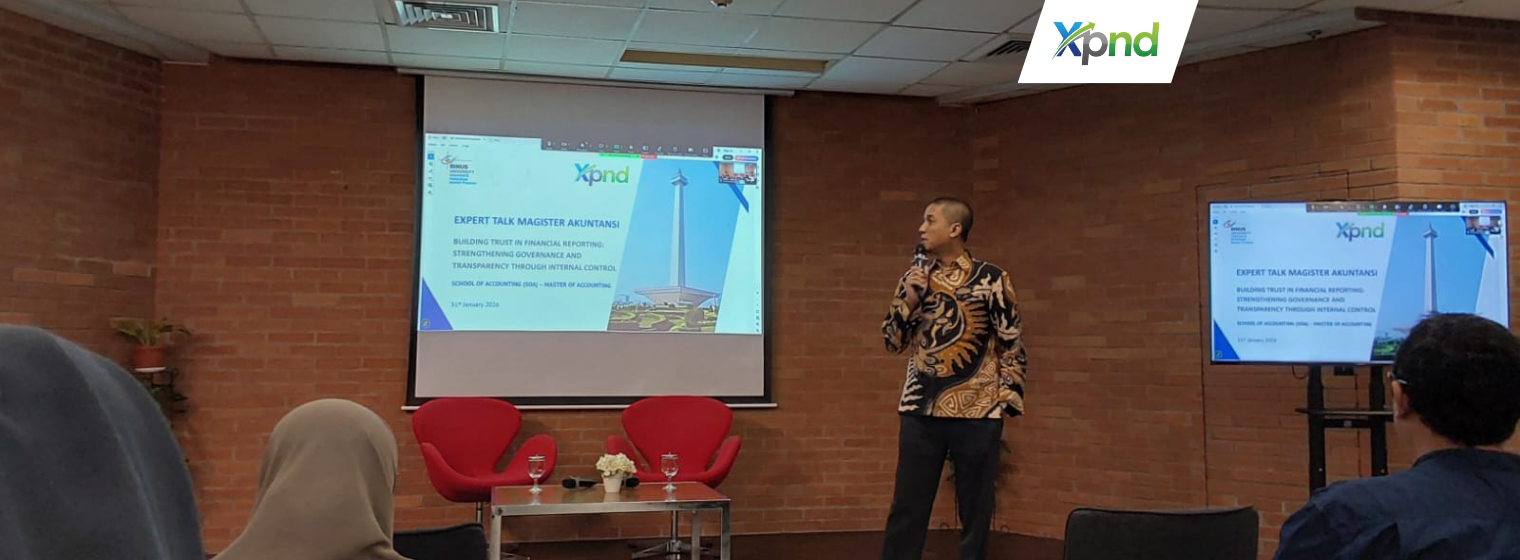
This was highlighted by Vidvant Brahmantyo, CEO of XPND Indonesia, during the Expert Talk organized by the Master of Accounting Program at BINUS University on Saturday, January 31, 2026, at the BINUS Anggrek Campus.
Carrying the theme “Building Trust in Financial Reporting: Strengthening Governance and Transparency Through Internal Control,” Vidvant emphasized the importance of implementing Internal Control over Financial Reporting as a key mechanism to ensure accurate, transparent, and reliable financial statements.
According to him, many corporate failures across various countries are not solely caused by weak business performance. A significant number of cases are rooted in ineffective internal control systems.
“Financial statements may appear strong in numbers, but without robust internal control, the risks of material misstatements, manipulation, and fraud will always exist. This ultimately undermines public trust,” Vidvant explained during the discussion session.
He further elaborated that internal control is not simply a set of administrative procedures. It is a comprehensive process involving people, technology, and organizational culture. The system is designed to ensure balanced achievement of operational objectives, reliable reporting, and regulatory compliance.
In his presentation, Vidvant highlighted how the internal control approach has evolved over time. Previously focused mainly on compliance, it has now become a strategic tool supporting management decision making and corporate risk management.
International frameworks such as COSO and the Three Lines Model demonstrate how internal control connects business strategy, risk management, and organizational accountability.
Through real case examples from his experience in auditing and consulting, Vidvant illustrated that system failures are often not caused by the absence of regulations. Challenges emerge when internal control is not integrated into daily business processes and corporate culture.
The discussion was moderated by Rosaline Tandiono, Head of the Master of Accounting Department at BINUS University, who guided participants to understand the importance of synergy between management, internal auditors, and external auditors in maintaining high quality financial reporting.
This Expert Talk served as a reflection that modern accounting education must go beyond technical aspects of recording and reporting. Strong knowledge of corporate governance, risk management, and internal control has become a critical competency for today’s accounting professionals.
At the end of the session, Vidvant emphasized that building credible financial statements requires a structured and sustainable approach. Companies need strategic partners to support the design of effective internal control systems aligned with business objectives.
The Role of XPND Indonesia in Supporting Credible Financial Reporting
As a consulting firm focused on corporate governance, auditing, and financial system strengthening, XPND Indonesia serves as a strategic partner in developing transparent and reliable financial reporting systems.
Through an integrated approach encompassing governance, risk management, and internal control, XPND Indonesia assists organizations in designing and implementing control systems aligned with business processes and regulatory requirements.
This comprehensive support ensures that financial statements not only meet compliance standards, but also function as credible decision making tools for management and stakeholders.