


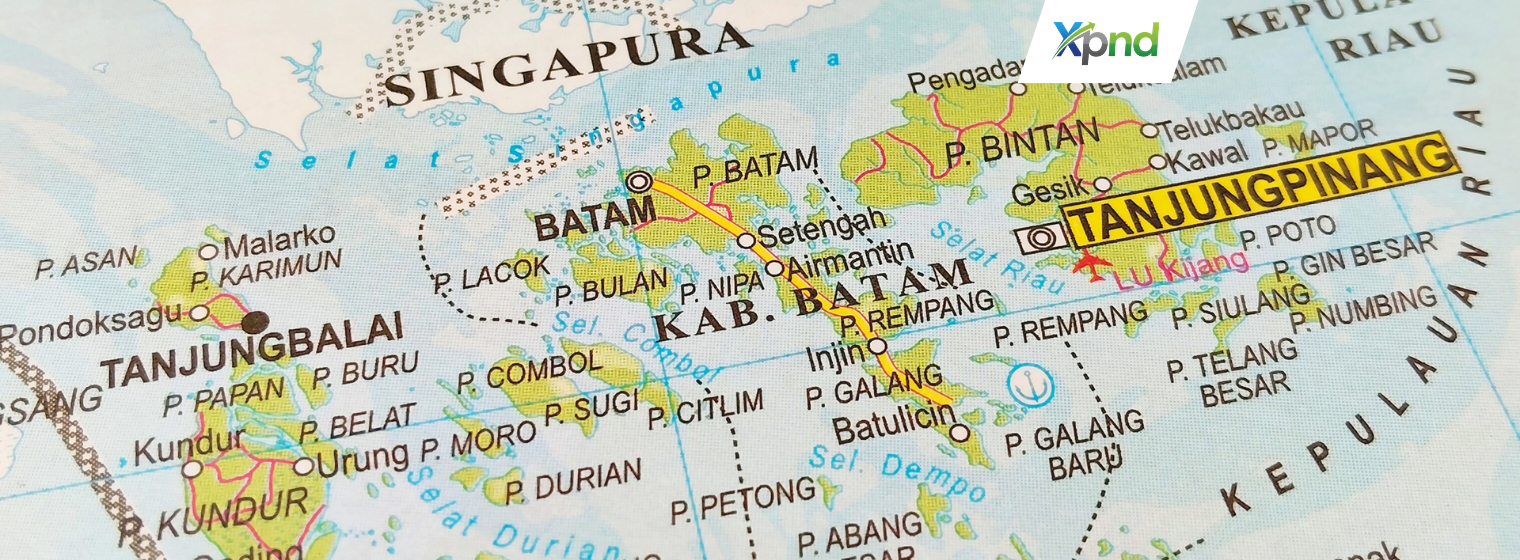




Most foreign investors researching Indonesia eventually end up comparing Jakarta and Bali. Batam rarely makes the shortlist at first glance. That tends to change quickly once they understand what Batam actually offers: the only island in Indonesia with Free Trade Zone status that also sits 20 kilometres from Singapore, on one of the world’s busiest shipping lanes.
For companies in manufacturing, logistics, electronics, shipbuilding, or any business that depends on import and export flows, that combination is difficult to replicate anywhere else in the country. Batam is not trying to compete with Jakarta as a services hub or with Bali as a lifestyle destination. It is competing as a manufacturing and trade platform with a cost structure and geographic position that most of Indonesia simply cannot match.
This guide covers what foreign investors need to know before setting up in Batam: what makes it structurally different, which sectors are most active, how the FTZ status and the 2025 expansion affect operations, and how to incorporate correctly as a foreign-owned company while capturing the full set of benefits the zone offers.
What Makes Batam Different from Other Indonesian Cities
The difference starts with the regulatory layer. Batam operates under a dual framework that no other Indonesian city has. It is simultaneously a Free Trade Zone and home to multiple Special Economic Zones (Kawasan Ekonomi Khusus or KEK). These are not interchangeable terms, and understanding the distinction matters for how you structure your operations.
The FTZ status covers Batam and its surrounding islands, governed by Government Regulation Number 41 of 2021 on the Administration of Free Trade Zones and Free Ports, as reinforced by Government Regulation Number 25 of 2025. Under this framework, goods imported into Batam for use in business operations are exempt from import duty, Value Added Tax (PPN), and luxury goods sales tax (PPnBM). This applies to raw materials, machinery, components, and finished goods used within the zone. The tax relief is not an incentive that requires a separate application. It applies by default to qualifying goods brought into the FTZ.
The 22-Island Expansion Under PP 47/2025
Government Regulation Number 47 of 2025 significantly expanded Batam’s FTZ boundaries from the original eight islands to twenty-two, opening additional land supply within the zone, introducing dedicated zoning for new areas including Hang Nadim Aerocity for aviation and high-technology manufacturing, and integrating surrounding maritime zones into the FTZ framework with clearer legal footing for shipbuilding and offshore fabrication companies. The full regulatory and investment implications of this expansion, including what it means for companies already operating in Batam and those evaluating entry, are covered in detail in XPND’s dedicated analysis of the PP 47/2025 FTZ Batam expansion.
The Special Economic Zones sit within Batam and offer deeper, sector-specific benefits layered on top of the FTZ framework. The Nongsa Digital Park SEZ focuses on technology, research and development, creative industries, and data centers. Batam Aero Technic SEZ specializes in aircraft maintenance, repair, and overhaul. These zones offer income tax holidays and investment allowances that go beyond what the general FTZ provides, and they require a formal application and approval process managed by the relevant KEK authority rather than BP Batam’s standard permits.
Batam is managed by the Batam Free Trade Zone and Free Port Authority (Badan Pengusahaan Kawasan Perdagangan Bebas dan Pelabuhan Bebas Batam or BP Batam), which functions as the governing body for investment, licensing coordination, land allocation, and infrastructure development on the island. For foreign investors, BP Batam serves as the primary government counterpart for sector-specific permits and FTZ benefit access, operating alongside the national OSS-RBA system.
The Business Sectors That Drive Batam’s Economy
Batam has historically been built around industries that benefit directly from its location and FTZ status. BP Batam officially identifies two broad categories: manufacturing and services. Within those, the most established sectors are:
- Electronics and electrical components. Batam has hosted electronics assembly, PCB manufacturing, and semiconductor packaging since the 1970s. The Batamindo Industrial Park and the Muka Kuning corridor remain the center of this cluster, with deep supply chain infrastructure that reduces input costs for new entrants.
- Shipbuilding and marine services. Tanjung Uncang is Indonesia’s most concentrated shipbuilding cluster, with over 130 shipyards handling construction, repair, and offshore fabrication. Deep-water access, a workforce trained in marine engineering, and the proximity to Singapore’s maritime shipping lanes make this one of Batam’s most defensible competitive advantages.
- Oil and gas services and offshore fabrication. Subsea engineering, fabrication yards, and supply-base operations represent a significant part of Batam’s industrial base, driven by the oil and gas activity in the Malacca Strait and surrounding waters.
- Logistics and warehousing. Bonded warehousing, transhipment operations, and regional distribution centers benefit from Batam’s port infrastructure and direct ferry connections to Singapore. Batu Ampar Port is undergoing expansion targeting significantly higher annual container handling capacity.
- MRO, technology, and digital services. The Batam Aero Technic SEZ anchors the MRO segment, while Nongsa Digital Park is positioning Batam as a technology and digital services hub for Singapore-adjacent operations.
For companies entering any of these sectors, the KBLI code selected at incorporation determines not only the OSS licensing pathway but also eligibility for FTZ benefits, access to SEZ incentives where applicable, and the specific permits BP Batam will process. A company registering under a manufacturing KBLI operates under different requirements than one registering under a trading or services code. Getting the KBLI right from the start prevents licensing gaps that are expensive and time-consuming to correct after the fact. The KBLI 2025 classification framework, which restructured business codes under BPS Regulation Number 7 of 2025, applies to all new PT PMA registrations in Batam as it does elsewhere in Indonesia.
How the Dual Licensing Track Works in Practice
This is the aspect of Batam incorporation that most standard guides understate, and it is where the setup process diverges most sharply from Jakarta or Bali.
Every PT PMA in Batam registers through the national OSS-RBA platform under Government Regulation Number 28 of 2025. This produces the NIB and the sector-specific licenses that correspond to the company’s KBLI classification. That process runs identically here as anywhere in Indonesia.
What Batam adds is a second track through BP Batam. The main permit BP Batam issues for companies operating within the zone is the Izin Usaha Kawasan (IUK), which authorizes a company to operate within a specific industrial area and access the FTZ’s fiscal benefits. This is not a duplicate of the OSS license. It is a distinct authorization that the OSS system does not process. Until the IUK is in place, a company may hold a valid NIB but cannot legally access import duty exemptions, VAT relief, or bonded zone facilities.
BP Batam applications are submitted through the IBOSS (Investment Board One-Stop Service) portal. The required documentation includes:
- The registered PT PMA entity documents (deed, Kemenkumham ratification, NPWP)
- Shareholder and director identification (passport for foreign nationals)
- A business plan demonstrating that the activity falls within BP Batam’s eligible sector list
- Proof of land or facility: either a lease from BP Batam directly or a lease from an approved industrial estate operator within the zone
- Evidence of capital meeting BKPM Regulation Number 5 of 2025 thresholds (IDR 2.5 billion paid-up, IDR 10 billion investment commitment per KBLI per project location)
- Environmental clearance appropriate to the activity scale (UKL-UPL for most standard operations, AMDAL for high-impact activities)
The OSS plus BP Batam licensing process, when documentation is complete and the KBLI is correctly matched to the intended activity, typically runs around twenty working days. Companies entering SEZ territories face an additional approval layer with its own timeline.
Explore Our Services Establish Your PT PMA in Indonesia
Industrial Estate Selection: A Decision That Shapes Operations
Batam is not a uniform zone. Its industrial estates have distinct sector focuses, infrastructure profiles, and relationships with BP Batam’s permitting processes. The estate a company selects affects its supply chain access, infrastructure quality, land lease terms, and proximity to sector-specific partners.
Land in Batam is not freehold. Companies lease from BP Batam directly or from approved industrial estate operators, typically on terms of thirty years renewable. Lease agreements must be in place before BP Batam will process an IUK application, which means securing the land commitment runs in parallel with incorporation rather than after it.
Tanjung Uncang: Shipbuilding and Marine
Tanjung Uncang is the primary shipbuilding cluster, offering deep-water access of approximately 7.5 meters and a dense concentration of subcontractors covering steel, welding, electrical, and structural fabrication. For PT PMA entities in marine construction, offshore fabrication, or ship repair, the supply chain density here is inseparable from the economics of the sector. Isolated locations elsewhere in the zone require importing the same supply chain infrastructure that Tanjung Uncang already provides.
Batamindo and Muka Kuning: Electronics and Precision Manufacturing
The Batamindo Industrial Park and the Muka Kuning corridor are the established centers for electronics assembly, precision components, and export-oriented light manufacturing. The workforce in this area carries decades of manufacturing experience calibrated to the technical requirements of the sector. BP Batam’s permitting for industrial activities here is among the most standardized in the zone, given the volume of established precedents.
Nongsa: Digital Economy and Technology
Nongsa Digital Park’s SEZ designation makes it the correct location for technology companies, software development, R&D, creative industries, and data centers. The SEZ incentives available here, including income tax holidays and investment allowances, require a separate qualification process from the standard BP Batam IUK. For companies whose activities genuinely fit the Nongsa SEZ’s scope, the additional process is worth pursuing. For companies that do not, registering a Nongsa address solely to access the SEZ incentives without the underlying qualifying activity creates the same compliance risk that mismatched KBLI selection does.
Hang Nadim Aerocity: Aviation and High-Technology Manufacturing
Introduced under PP 47/2025, Hang Nadim Aerocity is the newest designated zone within the expanded FTZ. Planned around the international airport, it targets air logistics, aerospace manufacturing, and high-technology industrial activities that require direct airport connectivity. As a recently designated area, the full infrastructure buildout and BP Batam processing framework are still maturing, but for companies whose operational model is structured around air freight and aviation-adjacent manufacturing, it represents a location category that did not previously exist within Batam’s FTZ.
Goods Movement Between the FTZ and Indonesia’s Domestic Market
This is the operational planning issue that most frequently surprises PT PMA operators who were focused on understanding FTZ benefits without fully examining when those benefits stop applying.
Within the FTZ, goods move without import duty, VAT, or luxury goods tax. That framework functions as described so long as goods remain within the zone or are exported internationally. The complication arises when goods produced or held within the FTZ are sold into Indonesia’s domestic customs territory (Daerah Pabean Indonesia Lainnya or DPIL), meaning to customers on the Indonesian mainland.
Under Indonesian customs law, a transaction from the FTZ into the domestic market is treated as an import. Import duties and applicable taxes are assessed at the point of goods crossing from the zone into domestic territory, at the same rates that would apply if those goods had been imported from overseas. For a manufacturing PT PMA whose entire output is exported internationally, this rule creates no friction. For a company that produces in the FTZ but sells a portion of its output to Indonesian domestic customers, those sales generate customs obligations that are structurally similar to a standard import transaction.
The split between export-oriented and domestic-market sales therefore affects the effective tax position of the business in ways that the headline FTZ description does not capture. This needs to be planned before the PT PMA’s investment plan is declared in OSS, because the KBLI selection, declared business scope, and projected realization structure should accurately reflect how the company’s revenue will actually be generated. The tax compliance framework for foreign companies operating in Indonesia provides the broader context for how these obligations interact with corporate income tax and VAT positions once operations are running.
Capital Requirements, Physical Address, and Immigration
Under BKPM Regulation Number 5 of 2025, the minimum paid-up capital for a PT PMA is IDR 2.5 billion, replacing the previous IDR 10 billion minimum. The minimum total investment plan remains above IDR 10 billion per five-digit KBLI code per project location, excluding land and buildings. This is the commitment figure declared in OSS and expected to be realized over the course of operations. Paid-up capital is subject to a 12-month lock-in period from the date of deposit.
Virtual office arrangements that may be acceptable in Jakarta do not satisfy Batam’s requirements for manufacturing or industrial PT PMA operations. A physical address is a standard licensing condition for BP Batam’s IUK, and the address must be within a commercial or industrial zone appropriate to the declared KBLI activity. Securing the physical premises, whether through a direct BP Batam land lease or through an approved industrial estate operator, should be initiated concurrently with notary engagement rather than treated as a post-incorporation step.
Most foreign companies setting up manufacturing or operational facilities in Batam will need to place foreign professionals on the ground. The Investor KITAS pathway allows a foreign shareholder to obtain a limited stay permit based on their investment stake in the PT PMA. For expatriate employees in technical or managerial roles, a work permit (IMTA) and limited stay permit require an approved RPTKA (Foreign Manpower Utilization Plan) that maps each foreign position to a corresponding Indonesian counterpart and training commitment. In Batam’s manufacturing context, engineering, plant management, and quality assurance roles are among the most commonly filled by expatriates, and the RPTKA documentation for these roles needs to accurately reflect the company’s operational structure.
Post-Incorporation Compliance in Batam
The compliance calendar for a Batam PT PMA covers the same national obligations as any PT PMA in Indonesia, plus ongoing engagement with BP Batam for permit renewals and activity reporting.
As a PT PMA, the company must submit quarterly Investment Activity Reports (LKPM) to the Ministry of Investment, tracking capital realization against the declared investment plan. Under BKPM Regulation Number 5 of 2025, LKPM deadlines fall on the 15th of April, July, October, and January each year. Beyond LKPM, the company carries corporate income tax obligations, monthly employee income tax withholding under the PPh 21 framework, VAT filing where applicable, BPJS contribution management, and the annual general meeting and corporate secretarial cycle under Minister of Law Regulation Number 49 of 2025.
The full picture of a PT PMA’s compliance obligations, from monthly filings through annual reporting, needs to be built into the operational budget before setup begins. Companies that treat compliance as an afterthought often discover the accumulated cost of late filings, penalty assessments, and corrective administrative work is substantially higher than what structured ongoing compliance would have cost from the outset.
XPND has a dedicated office in Batam, meaning the incorporation, immigration, and compliance support provided here is grounded in direct experience with the local licensing environment, BP Batam processes, and the specific requirements that apply to businesses operating within the FTZ. For companies entering Batam for the first time, XPND handles PT PMA incorporation from KBLI classification and capital planning through OSS-RBA registration and BP Batam IUK coordination. For companies already operating and seeking to put compliance on a structured footing, the Business Process Outsourcing services cover tax compliance, corporate secretary, and LKPM reporting as an ongoing managed service. Reach out to the XPND Batam team to understand what the setup process looks like for your specific business model before investment commitments are made.