


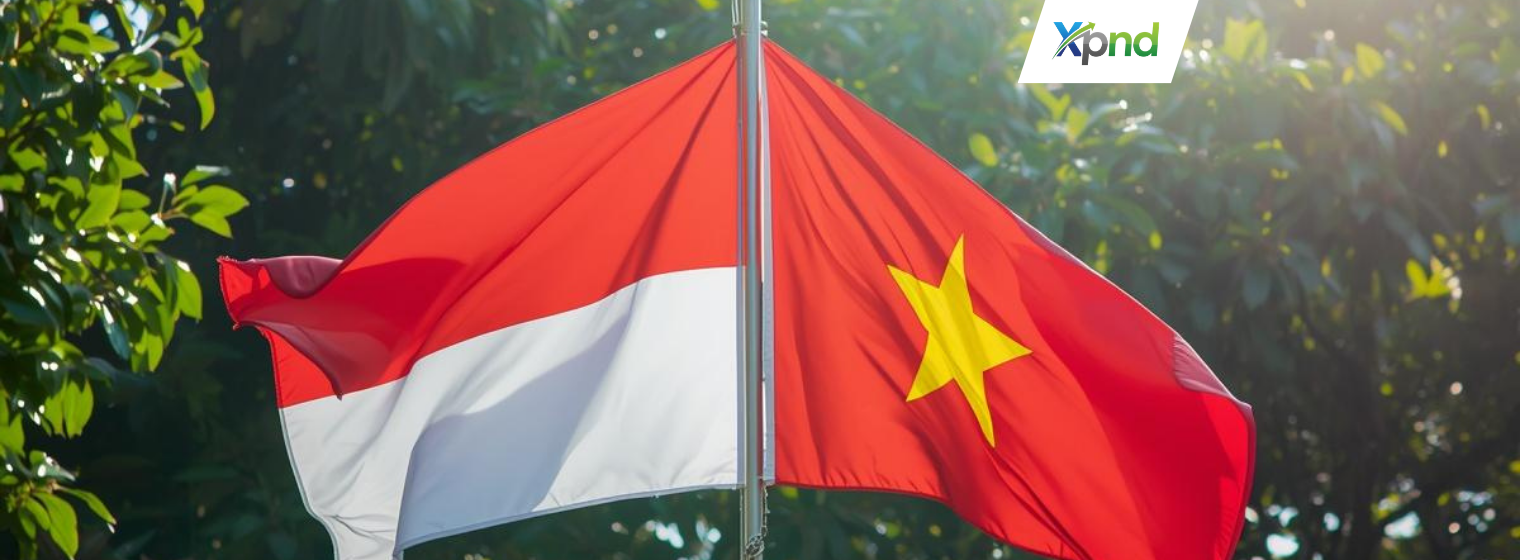




Indonesia vs Vietnam: which is better for doing business depends on what your company does. Indonesia is mainly a domestic market play: a large consumer base, a services-led economy and a 100% foreign ownership route in many sectors. Vietnam is mainly an export and manufacturing play, with a lower headline corporate tax rate and a wider trade agreement network. This guide compares company setup, tax, labor and market fit, using the rules in force in October 2026, and shows where the differences change the decision.
Indonesia vs Vietnam at a Glance
| Indonesia | Vietnam | |
| Economic growth, 2025 | 5.11% (BPS) | 8.02% (National Statistics Office) |
| GDP per capita, 2025 | USD 5,083 (BPS) | USD 5,026 (government estimate) |
| GDP, 2025 | IDR 23,821.1 trillion (BPS), roughly USD 1.4 trillion at about IDR 16,500 per USD | About USD 514 billion (government estimate) |
| Population | Over 280 million | About 100 million |
| Foreign investment trend | Realized foreign investment of IDR 900.9 trillion in 2025, up 0.1% on 2024 (BKPM) | Disbursed FDI of USD 13.03 billion in the first half of 2026, up 11.2% year on year (Vietnam National Statistics Office) |
| Main strength for a foreign company | Domestic consumer market | Export manufacturing and supply chains |
Company Setup: What It Takes
Indonesia
A foreign company usually enters through a PT PMA, a foreign-owned limited liability company licensed through the OSS system. The main requirements are:
- Investment value: more than IDR 10 billion per five-digit KBLI code per project location, excluding land and buildings, with exceptions for wholesale trade, construction, food and beverage services and industry (BKPM Regulation 5/2025, Article 26(2) and (3)).
- Paid-up capital: at least IDR 2.5 billion per company, which cannot be moved out of the company’s account for 12 months except to buy assets, build premises or run operations (Articles 26(10) and 27).
- Shareholders: a limited liability company needs at least two shareholders.
- Foreign ownership: up to 100% in many sectors, subject to the investment list for each business field.
Our guides to PT PMA minimum capital, the PT PMA establishment cost and whether a virtual office is permitted for a PT PMA cover the details. If you want XPND to handle it, see our PT PMA setup service.
Vietnam
Vietnam’s amended Investment Law, passed in December 2025, took effect on 1 March 2026, and its new framework for conditional business lines applies from 1 July 2026. Reports describe the changes as removing 38 conditional business lines and allowing a company to be set up before the project approval is issued. The investment registration certificate is still required, and market access conditions still apply when the company is incorporated. Vietnam does not set one minimum capital figure for every business, but some sectors do carry capital requirements. Because the implementing decrees are still being issued, check the current position for your sector before you plan a timeline.
Explore Our Services Establish Your PT PMA in Indonesia
Taxes: The Numbers That Matter
| Indonesia | Vietnam | |
| Standard corporate tax | 22% | 20% |
| Small-business regime | 50% discount on the rate for the part of taxable income from turnover up to IDR 4.8 billion, for companies with turnover up to IDR 50 billion (Article 31E) | 15% for micro enterprises (revenue up to VND 3 billion) and 17% for small enterprises (VND 3 billion to VND 50 billion), from 1 October 2025 (Law 67/2025/QH15) |
| VAT | 12% rate, applied on 11/12 of the tax base for most goods and services, so the effective rate is 11%; luxury goods bear 12% (PMK 131/2024) | 10% standard; 8% reduced rate until 31 December 2026 for covered goods and services (Resolution 204/2025/QH15) |
| Investment incentives | Corporate tax holiday for pioneer industries: for investment of at least IDR 100 billion, a 50% reduction for 5 years, or 100% for investment of at least IDR 500 billion for 5 to 20 years depending on size (PMK 130/2020) | Incentives depend on the industry and location; from 1 October 2025 the new law narrows which industries and areas qualify |
Indonesia
Corporate tax is 22%. The small-business discount is often described as an effective 11% rate, but it applies only to the part of taxable income tied to turnover up to IDR 4.8 billion, so most growing companies pay the full rate on the rest. VAT is 12% on paper and 11% in effect on most domestic supplies; our guide to VAT (PPN) in Indonesia for foreign companies explains the mechanism. Groups with consolidated revenue of at least EUR 750 million also fall under the global minimum tax introduced by PMK 136/2024.
Vietnam
Corporate tax is 20%, with lower rates for micro and small enterprises under the new corporate income tax law that took effect on 1 October 2025. The 8% VAT rate is temporary and excludes sectors such as finance, telecommunications and real estate. The headline rate is lower than Indonesia’s, but what you actually pay depends on the incentive you qualify for and your location.
Labor and Employment
Indonesia
Employment is governed by Law 13 of 2003 as amended by the Job Creation Law framework, with Government Regulation 35 of 2021 on fixed-term contracts, outsourcing, working hours and termination. A new Labour Protection Law was passed by the House of Representatives on 6 October 2026. At the time of writing it had not yet been promulgated, and the labor ministry has said it will apply one year after promulgation. Until then, the existing framework applies, so plan contracts with the transition in mind. For the current rules, see our Indonesia labor law guide for foreign companies. Foreign staff need a stay permit and, in most cases, an approved manpower plan; our guide to the Investor KITAS and work permit process explains the difference.
Vietnam
Employment follows the Labor Code 2019. For Vietnamese employees, employers pay social insurance at 17.5% of salary, health insurance at 3% and unemployment insurance at 1%, a total of 21.5% of salary up to a monthly ceiling. Budget for the full 21.5%, not only the 17.5% social insurance figure. Rates for foreign employees differ (unemployment insurance does not apply), so confirm them with a Vietnamese payroll adviser. Foreign employees need a work permit issued through the labor ministry.
Explore Our Services Recruitment in Indonesia
Market Access and Strategic Fit
Indonesia is mainly a domestic market play. With a population of over 280 million and a large services sector, it suits companies that sell to Indonesian consumers and businesses. Local content rules, known as TKDN, can matter for government procurement and some industries; they were revised under Industry Ministry Regulation 35/2025.
Vietnam is mainly an export and manufacturing play. It has a dense network of industrial parks and trade agreements such as the CPTPP and the EU-Vietnam free trade agreement, which suit companies building an export base in Southeast Asia. Indonesia is also part of the regional trade network through ASEAN and RCEP, which entered into force for Indonesia on 2 January 2023. Its trade agreement with the EU was signed in September 2025 but has not yet entered into force, so check its status before relying on it.
Regulatory Complexity and Practical Considerations
Indonesia’s licensing runs through the OSS risk-based system. A mistake in the business activity codes, the location or the investment figure can delay or block a licence, as our guides to the OSS RBA system in 2026 explain. Vietnam is moving through its own set of changes in 2026, with implementing decrees still arriving. In both countries, a company that plans its structure before filing avoids most of the delays. XPND’s market entry strategy service is built for that stage.
Which Should You Choose?
| If your plan is… | Lean towards |
| Selling to Indonesian consumers or businesses | Indonesia |
| Manufacturing for export | Vietnam |
| Services with regional clients, no local factory | Either; compare tax, hiring and licensing for your activity |
| A long-term presence in Southeast Asia’s largest economy | Indonesia |
| A shorter route to export trade agreements | Vietnam |
Many companies end up with both. If you are leaning towards Indonesia, contact XPND for a free first assessment of your structure.