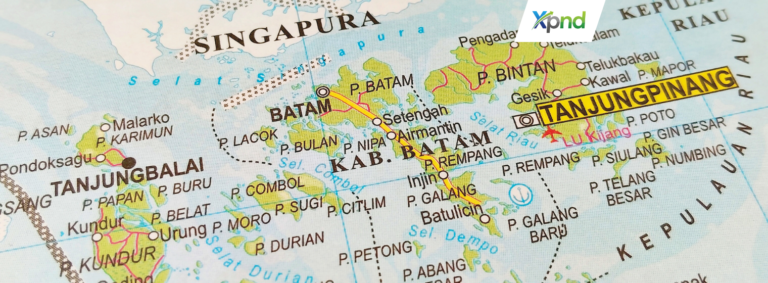








Batam sits 20 kilometers from Singapore’s southern coast. That proximity is the entire point. For manufacturing companies, electronics assemblers, logistics operators, and shipbuilders, Batam’s geographic position combined with its Free Trade Zone status creates a cost structure that is genuinely difficult to replicate elsewhere in Indonesia. Goods enter the island without import duty, without VAT, and without luxury goods tax. The customs clock runs differently here.
What does not run differently, however, is Indonesian labor law. The moment a company in Batam hires its first employee, it enters the same payroll compliance framework that governs every other employer in the country: PPh 21 income tax withholding, five BPJS contribution programs, regional minimum wage obligations, mandatory THR disbursement, Coretax reporting, and the full severance calculation architecture under Government Regulation No. 35 of 2021. None of this is suspended by FTZ status.
What makes payroll services in Batam distinct from a generic Indonesian payroll setup is not the regulatory framework itself; it is the specific numbers, the workforce composition that manufacturing-heavy operations produce, and the layered wage obligations that Batam’s industrial economy generates. Getting those specific variables right is where most compliance exposure concentrates.
The Wage Floor That Changes Everything
Batam holds the highest city-level minimum wage (Upah Minimum Kota or UMK) in Kepulauan Riau Province. For 2026, the UMK Batam was set at IDR 5,357,982 per month, effective 1 January 2026, formalized under Governor’s Decree No. 1332 of 2025. This represents a 7.38 percent increase from the 2025 figure of IDR 4,989,600, calculated using the formula under Government Regulation No. 49 of 2025 with an alpha coefficient of 0.70.
That figure is not just a salary floor. It is the base from which an entire cascade of costs is calculated:
- Overtime rates are derived from 1/173 of the monthly wage under PP No. 35 of 2021, so every overtime hour in a Batam factory carries a higher monetary value than the same hour in a lower-wage province.
- BPJS Ketenagakerjaan contributions across all applicable programs use the reported wage as their basis. For workers earning at or near the UMK, the combined employer contribution cost adds several hundred thousand rupiah per employee per month, on top of the base wage.
- BPJS Kesehatan employer contributions (4% of reported salary, up to the applicable ceiling) also scale directly with the wage base.
- THR reserves must be planned from the start of the fiscal year. A company with 200 production workers at UMK pays the equivalent of one full month’s payroll as THR, disbursed no later than seven days before the employee’s religious holiday under Ministerial Regulation No. 6 of 2016.
For companies operating at scale in Batam’s industrial estates, the difference between mistakenly applying the provincial UMP (IDR 3,879,520) and the correct UMK is IDR 1,478,462 per employee per month. That is not a rounding error. Across a workforce of 200 people, that gap compounds into a substantial annual underpayment exposure, which carries not only back-pay liability but potential administrative sanctions from the local Dinas Tenaga Kerja. The full UMP and UMK breakdown for 2026, including rates across Indonesia’s main industrial cities and the three compliance failures that appear most often in audits, is worth reading before the first payroll cycle runs.
Explore Our Services Payroll Management in Indonesia
Workforce Composition: The Variable Most Payroll Setups Underestimate
Batam’s dominant economic sectors are electronics manufacturing, shipbuilding and MRO, logistics, and increasingly digital technology through the Nongsa Digital Park KEK. Each sector carries a different workforce profile, and that profile shapes payroll complexity directly.
A mid-size electronics manufacturer in Batam might run a workforce that includes permanent production workers (PKWTT) on monthly salary, fixed-term contract workers (PKWT) with pro-rata THR obligations, and expatriate technicians or directors whose payroll involves separate tax withholding rules and BPJS enrollment requirements. Managing all three categories simultaneously, with different compliance calendars and contribution structures for each, is where in-house payroll teams tend to accumulate undetected errors.
Why Contract Type Is a Payroll Risk, Not Just an HR Classification
The distinction between PKWTT and PKWT is not merely administrative. A PKWT used for a role that should legally be PKWTT converts to permanent status automatically from day one of employment under PP No. 35 of 2021. That conversion resets the entire severance calculation basis retroactively. Companies that have been running large numbers of contract workers in core production roles without proper contractual documentation are accumulating a latent liability that surfaces at termination. The severance calculation itself, including how PP No. 35 of 2021 governs each termination ground and the multipliers that apply, is covered in detail in this guide to Indonesia severance pay and worth reviewing before any employment arrangement is locked in.
Expatriate Payroll and the Immigration Compliance Link
Many companies operating in Batam bring in expatriate workers for technical roles, particularly in electronics assembly, MRO, and maritime engineering. An expatriate on a Working KITAS carries BPJS Ketenagakerjaan enrollment obligations from the employer side. Their salary, if reported under PPh 21 rather than PPh 26, requires a different withholding calculation. Their termination triggers severance obligations under the same framework that governs local employees.
More practically, any deficiency in the company’s payroll compliance record, including outstanding BPJS contributions or delayed tax filings, creates a blocking condition for RPTKA processing and work permit renewals. The Ministry of Manpower’s digital systems increasingly cross-check compliance status before approving foreign worker utilization plans. How this cross-check works in practice, and what the full work permit requirements in 2026 actually entail for employers, is where many companies discover the payroll-immigration dependency too late.
For companies that are still setting up their legal entity in Batam, this link between payroll readiness and immigration clearance is worth understanding before the first hire. The FTZ licensing structure, the role of BP Batam, and the full company formation sequence are covered in this guide to setting up business in Batam as a foreign investor, which gives the structural context that payroll decisions sit inside.
Tax and Social Security: Where the Technical Errors Concentrate
PPh 21 Under the TER Method
Indonesia’s income tax calculation for employees has operated under the Average Effective Rate (Tarif Efektif Rata-rata or TER) method since January 2024, established under Government Regulation No. 58 of 2023. Under TER, the monthly withholding rate is determined by a table that cross-references the employee’s estimated annual income bracket with their non-taxable income threshold (PTKP) status. The December payroll requires a full reconciliation against the progressive rates under Article 17 of the Income Tax Law.
For a Batam manufacturer running monthly payroll across hundreds of employees with different PTKP categories, the TER table application is not technically complex in isolation. What creates errors is the surrounding data quality:
- NIK-to-NPWP synchronization: The DJP Coretax system requires each employee’s National Identity Number (NIK) to be linked to a valid NPWP. Workers without a valid NPWP face a higher withholding rate. For a large manufacturing workforce with frequent turnover, maintaining accurate NIK-NPWP data is an ongoing compliance task, not a one-time setup.
- BPJS deductibility: The employee-side BPJS contributions (JHT at 2%, JP at 1%, and BPJS Kesehatan at 1%) are deductible from taxable income for PPh 21 purposes. Getting these deductions wrong cascades directly into an incorrect withholding amount, which compounds at the December reconciliation.
- Overtime and variable pay components: Batam’s production workforce regularly generates overtime income. Inconsistent classification of overtime as a fixed or variable component affects both the TER bracket assignment and the year-end reconciliation accuracy.
These interdependencies are why payroll in a manufacturing-intensive environment tends to generate proportionally more year-end correction exposure than a small office-based operation. A single miscategorized allowance across 300 payslips produces a material reconciliation problem in December. The mechanics of how BPJS contributions interact with PPh 21 calculations, including the correct sequencing for foreign companies registering for the first time, are technical enough that getting them wrong in month one tends to compound through the entire fiscal year.
THR in a High-Turnover Manufacturing Environment
THR is not a concern that resolves itself at the organizational level if payroll data is simply kept current. In a Batam manufacturing operation where production headcount fluctuates seasonally and contract renewals are frequent, the THR calculation requires accurate, continuously updated length-of-service records for every employee.
The pro-rata calculation for employees with less than twelve months of service, set out in Ministerial Regulation No. 6 of 2016, requires the exact number of months worked against the correct THR wage base. Two specific errors appear most consistently in high-turnover environments:
- Resetting the service clock at contract renewal: Under the regulation, a PKWT contract renewed without interruption carries cumulative service. A worker who completed an initial 12-month contract on 31 December 2025 and immediately renewed from 1 January 2026 does not start from zero for THR purposes. Total elapsed service is what counts.
- Misclassifying wage components in the THR base: The THR calculation includes base salary plus fixed allowances. Non-fixed allowances tied to attendance or performance do not enter the calculation. Many companies running allowance-heavy compensation structures in manufacturing include transport or meal allowances in the THR base incorrectly, or conversely exclude positional allowances that should be included.
A late or incorrect THR payment carries automatic penalties under Article 10 of Ministerial Regulation No. 6 of 2016, starting at 5 percent of the total THR owed to each affected employee, with escalation potential through administrative channels including the possibility of business license suspension for companies with repeated violations. Given the enforcement environment around the annual Posko THR monitoring period, companies with unresolved payroll data issues going into that window face heightened scrutiny. The full picture of how THR applies to contract workers specifically, and what happens when the deadline is missed, including the 5% fine and its escalation path, is worth working through before the next Eid cycle begins.
What Outsourcing Payroll in Batam Actually Transfers
The case for outsourcing payroll in a manufacturing-intensive environment like Batam is partly about capacity and partly about institutional knowledge. Monthly payroll for a workforce of 150 production workers is not administratively simple. The calendar runs tight: attendance and overtime data must be consolidated, wage calculations must be validated against the current UMK and PTKP parameters, BPJS contributions must be paid to the correct accounts before the monthly deadline, PPh 21 withholding must be calculated and filed through Coretax, and payslips must be distributed in a format that employees can understand and retain.
An internal HR team managing this alongside recruitment, disciplinary procedures, contract administration, and immigration coordination is managing competing deadlines across every function simultaneously. A single person out sick during payroll close week creates a bottleneck with downstream consequences across tax, BPJS, and employment records.
What a professional payroll service provider transfers is not just the calculation task. It is the regulatory monitoring obligation, the system-level readiness for regulatory changes like wage ceiling adjustments or Coretax platform updates, and the accountability structure that comes from having a dedicated compliance function rather than a shared HR generalist carrying the load.
That is precisely what the Batam office handles, as part of a broader payroll management service that runs alongside tax compliance and HR administration for manufacturing and services companies across the island. Direct coordination with the Jakarta headquarters means regulatory updates from DJP, BPJS, and the Ministry of Manpower reach the payroll processing workflow without delay.
Whether the operation involves 20 employees or 500, the payroll variables unique to Batam, from the UMK level to the workforce complexity that manufacturing produces, require the same precision as the customs and tax incentive structures that made the island worth operating in to begin with. Errors in payroll do not announce themselves immediately. They accumulate quietly until an inspection, a disputed termination, or a failed RPTKA renewal makes the gap visible. At that point, the cost of correction is almost always higher than the cost of getting it right from the start.
Reach out to XPND’s Batam payroll team to review your UMK compliance, BPJS contribution structure, and THR calculation methodology before those gaps surface on their own.